
Should You Choose Workflows or AI Agents?
Businesses are adopting automation quickly, but the right approach depends on the task. Should you use a workflow that follows fixed steps, or an AI agent that can interpret information, make decisions, and take action? The answer depends on how predictable, complex, and judgment-driven the work is.
What's a Workflow?
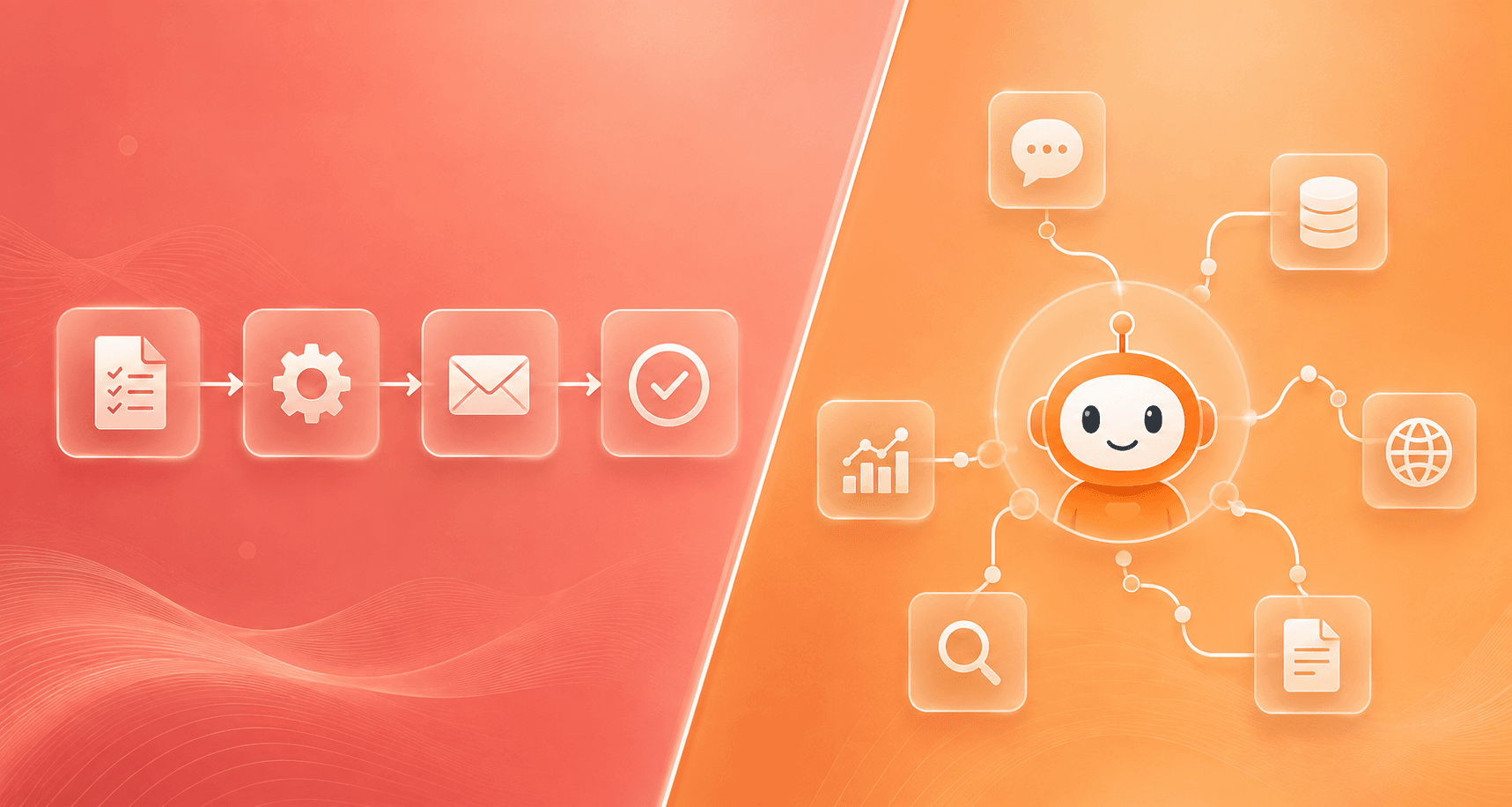
A workflow is a structured sequence of actions triggered by a specific event. For example, when a customer fills out a form, a workflow can:
- Add the customer to a database.
- Send a confirmation email.
- Notify the sales team.
- Create a follow-up task.
- Update the customer’s status.
Workflows are effective because they are consistent. They are designed for processes where the steps, conditions, and outcomes are mostly known in advance. Common workflow examples include:
- Sending onboarding emails
- Routing customer support requests
- Updating records across business systems
- Approving standard requests
- Creating invoices after a purchase
- Assigning leads to the right team
If the same event should produce the same series of actions every time, a workflow is usually the right starting point.
What Is An AI Agent?
An AI agent works toward a goal rather than simply following one fixed sequence.
An agent can interpret a request, gather information, choose the next step, use connected tools, and adjust its approach when circumstances change. For example, an AI agent asked to prepare a sales briefing might:
- Research the company.
- Review recent news.
- Identify relevant decision-makers.
- Summarize potential business needs.
- Draft talking points.
- Save the briefing for the sales representative.
The path may change depending on what the agent finds. That flexibility is what makes agents useful for tasks involving research, communication, prioritization, and decision-making.
The Key Differences Between Workflows and AI Agents
Workflows are best for predictable execution. AI agents are best for flexible tasks that require interpretation and judgment. Many businesses can benefit from using workflows for structured steps and AI agents for the parts of the process that require more adaptability.
How They Work
Workflows follow predefined steps. AI agents pursue a goal using context and reasoning. Workflows are designed around a fixed process, while AI agents can determine which actions to take based on the situation.
What They Are Best For
Workflows are best for repetitive, structured processes. AI agents are better for variable, judgment-heavy tasks where each request may require a different response.
How They Make Decisions
Workflows use rules and conditions to determine what happens next. AI agents interpret information and select actions based on context, instructions, and the goal they are trying to achieve.
How They Handle Exceptions
Workflows handle exceptions by adding additional rules. This works when unusual situations are predictable. AI agents can adapt to unfamiliar situations, which makes them more useful when requests vary significantly.
How Predictable They Are
Workflows offer high predictability because each step is defined in advance. AI agents are more flexible, but their results can vary depending on the task, the available information, and the quality of their instructions.
How Easy They Are to Set Up
Workflows are usually faster to set up because the process is clearly defined. AI agents require clearer instructions, access to the right tools, and safeguards that control what they can do.
How Much Oversight They Need
Workflows are easier to monitor because their actions follow a fixed structure. AI agents require monitoring and permission controls, especially when they access sensitive information, communicate externally, or take action independently.
When Should You Use A Workflow or AI Agent?
In this section, we'll discuss the right time and place to use workflows or AI agents or both.
Choose a Workflow When the Process Has Clear Rules
A workflow is a strong choice when:
- The same steps happen repeatedly.
- The required information is structured.
- The expected result is easy to define.
- Rules can cover most possible situations.
- Accuracy and consistency matter more than flexibility.
- You need a clear record of every action.
Imagine a company processing expense claims. If the process is always the same, a workflow can check the amount, verify the receipt, route the request for approval, and update the accounting system.
There is no need for an agent to make open-ended decisions. A reliable workflow can complete the task more quickly and with less oversight.
Choose an AI Agent When Each Request Requires Interpretation
An AI agent is more appropriate when:
- The input is written in natural language.
- The process involves research or analysis.
- Each request may require a different sequence of actions.
- Exceptions are common.
- The system needs to communicate with people.
- The agent must work across several tools.
- The final result depends on context.
Consider customer support. A workflow can route a ticket based on keywords. An AI agent can understand the customer’s actual problem, review account information, search relevant documentation, draft a response, and escalate the issue when necessary.
The agent is valuable because the task involves understanding and judgment, not just routing.
Use Both When the Process Has Structured and Flexible Parts
Many business processes need both approaches. A workflow can manage predictable stages, while an AI agent handles the parts that require interpretation. For example, a lead qualification process might work like this:
- A workflow receives a new lead.
- The workflow checks that the required fields are complete.
- An AI agent researches the company and identifies relevant signals.
- The agent recommends a lead score and drafts notes.
- The workflow assigns the lead to the correct salesperson.
- A human reviews the recommendation before outreach.
This arrangement gives the process structure while allowing the agent to handle research and judgment.
Avoid These Common Automation Mistakes
While automating your processes and operations are crucial to improving outcomes, you should avoid these common mistakes.
Using an AI Agent for a Simple Repetitive Task
If a task can be handled with a few clear rules, an AI agent may add unnecessary complexity. Use a workflow for predictable actions such as notifications, record updates, and standard approvals.
Building a Rigid Workflow for an Unpredictable Process
A workflow can become difficult to maintain when every exception requires another rule. If the process regularly involves unclear requests or changing circumstances, an AI agent may be better suited to that part of the work.
Giving an Agent Too Much Authority
An agent should have only the permissions it needs. Sensitive actions should require approval, especially when they involve financial transactions, external communications, confidential information, or permanent changes.
Automating a Broken Process
Automation increases the speed of a process. It does not automatically improve the process itself. Before building anything, identify unnecessary steps, unclear ownership, and inconsistent decision-making.
Measuring Activity Instead of Results
Track outcomes such as:
- Time save
- Completion rate
- Error rate
- Response time
- Customer satisfaction
- Revenue influence
- Number of tasks completed without escalation
The goal is better work, not simply more automated activity.
A Five-Question Test for Choosing the Right Approach
Ask these questions before automating a process:
- Are the steps known in advance?
- Does the process handle mostly structured information?
- How often do exceptions occur?
- Does the task require research, interpretation, or judgment?
- What level of approval is required before the system takes action?
Choose a workflow when the answers point to repeatability and control. Choose an AI agent when the answers point to flexibility, reasoning, and changing context.
Use both when the process contains a clear operational structure alongside tasks that require judgment.
Zetrix Avatar Scales Your Business Operations and Boosts Outcomes
Avatar is designed for AI agents that can represent you, handle conversations, execute tasks, and run repeatable workflows. Its platform combines autonomy, connected actions, scalable operations, and verifiable identity.
That makes Avatar useful when you need more than a single automated trigger. You can use an Avatar to manage conversations, support routine communications, carry out tasks, and coordinate workflows through one digital identity.
For businesses, this can include:
- Responding to routine inquiries
- Representing a team or brand
- Supporting outreach and client communication
- Running repeatable operational tasks
- Connecting agent actions to tools and services
- Scaling interactions while keeping messaging consistent
Explore Avatar to see how an AI agent can represent you and act on your behalf.
Supercharge Your Productivity With Avatar
Improve business outcomes with Zetrix Avatar. Represent your business and speed up low value tasks.
Try Avatar Today AVATAR 101
 AVATAR 101